01The seam
Third time through, the rain stops being rain.
Nothing about the audio changes. Same recording, same volume, same hiss against the glass. By the second pass you’ve learned the schedule. By the third, the sound has a shape you can see coming. A sound you can see coming is information. Weather is not.
Most people never catch the exact moment. They notice, somewhere around minute ten, that they’re listening to a track instead of a storm. Then the headphones come off.
A loop doesn’t wake you. It turns the room into furniture.
02The test
You can find your own seam in about four minutes.
Pick any ambient track. Play it three times. Don’t listen hard on the first pass; you won’t hear anything, and that’s the point. On the third pass, turn the volume down until it’s barely there.
Lower is better here. When the sound is quiet enough that texture drops out, change is the only thing left to notice. That’s when the join shows up: a small dip, a click, a swell that arrives a beat too early.
Then the more useful measurement. Once you’ve heard it, how long do you stay?
Some people last another twenty minutes. Some take the headphones off inside one. That number is yours, and it doesn’t transfer to anyone else. It’s also the only number in this article you can’t get from me.
03Restless, stuck, or numb
Ask ten people what repeated sound does and you’ll get ten answers, because “repeated sound” covers three situations that share nothing but the word.
Restless — a sound you didn’t ask for
A neighbour’s leak, a fan that won’t stop, an alarm two streets over. Your attention keeps getting pulled back, and the pulling is the unpleasant part. Nothing is being learned, nothing is resolved. If you’ve ever lain awake calculating how long until the dripping stops, you know the shape of it.
Stuck — a sound with a tune in it
A chorus, a jingle, four notes of something. Here repetition doesn’t stay outside you. The auditory system is very good at replaying a phrase it has just heard, which is why the song continues after the speaker is off. Ask anyone who has had the same eight bars in their head since Tuesday.
Numb — a sound with nothing in it
Rain, a hum, surf. The nervous system stops responding to it. Not because it’s boring — because the signal carries no news, and the filter that decides what reaches awareness closes. Within minutes you can’t hear it. Stop it and the silence is loud enough to startle you.
The third one is the odd one out, because it’s the only outcome you can want. The mechanism is the same either way; what changes is whether you asked for it. A sound you chose, that fades out of awareness, isn’t numbness. It’s a room.
Which is why a soundscape has exactly one job: get out of the way. And why half a second at the join can undo an hour of it.
04The thing adaptation can’t absorb
Adaptation has one condition: no news. It’s a filter that closes when nothing happens, and it reopens the moment something does.
Now put a seam in it.
A loop restart is small, but it is an event, and it arrives on a schedule. Your ear doesn’t have to be startled to notice it. By the second pass it knows where the join is, and a known join is easier to catch than an unknown one. So the filter reopens, the sound returns to the foreground, and then it has to close again. Every cycle.
The same thing happens in the room around you, which is why steady sound helps in the first place. Hearing never fully clocks off. It scans for the thing that changed, because for most of human history the thing that changed was the thing worth waking up for. In a flat that’s a door, a motorbike, a neighbour moving furniture. None of it is dangerous. All of it is a spike, and your alert system treats a spike as a spike.
Steady sound raises the floor. Put a low, even bed of rain under the room and a closing door is no longer a spike against silence; it’s a small bump against something already there. Fewer jolts, less scanning.
Then the part that gets skipped. A loop restart is also a spike. Smaller than a door, but worse in one specific way: you can prepare for it. Anticipation is not rest.
Why does the spike exist at all? Because a recorded clip has a phrase in it. Three minutes of rain isn’t uniform. It has a gust at the start, a car passing at 1:40, a drip pattern that resolves before the fade. Those are events, and events have edges. When the file wraps, the last edge meets the first edge, and your ear does the arithmetic.
So the problem was never repetition. Repetition is how the structure becomes visible. A texture can repeat forever without announcing itself. A phrase can’t.
That distinction is the whole game, and it’s why “make the loop longer” doesn’t solve anything. Twenty minutes of phrase, wrapped, is still a phrase with a start and an end. You’ve just given your ear more time to learn it.
05What we did instead
We didn’t remove the repetition. We removed the phrase.
Each of the forty soundscapes is built from twenty recordings, cut into ten layers. Every layer exists in two takes, a and b. The takes alternate, so the same piece of audio never plays twice in a row.
Each layer then runs on its own cycle. We measured them: the shortest comes back every 25 seconds, the longest every 18 minutes, and most sit between 60 and 110. Each cycle is stretched by a factor of 1.8 and offset by half a period, so no two layers land on the same beat.
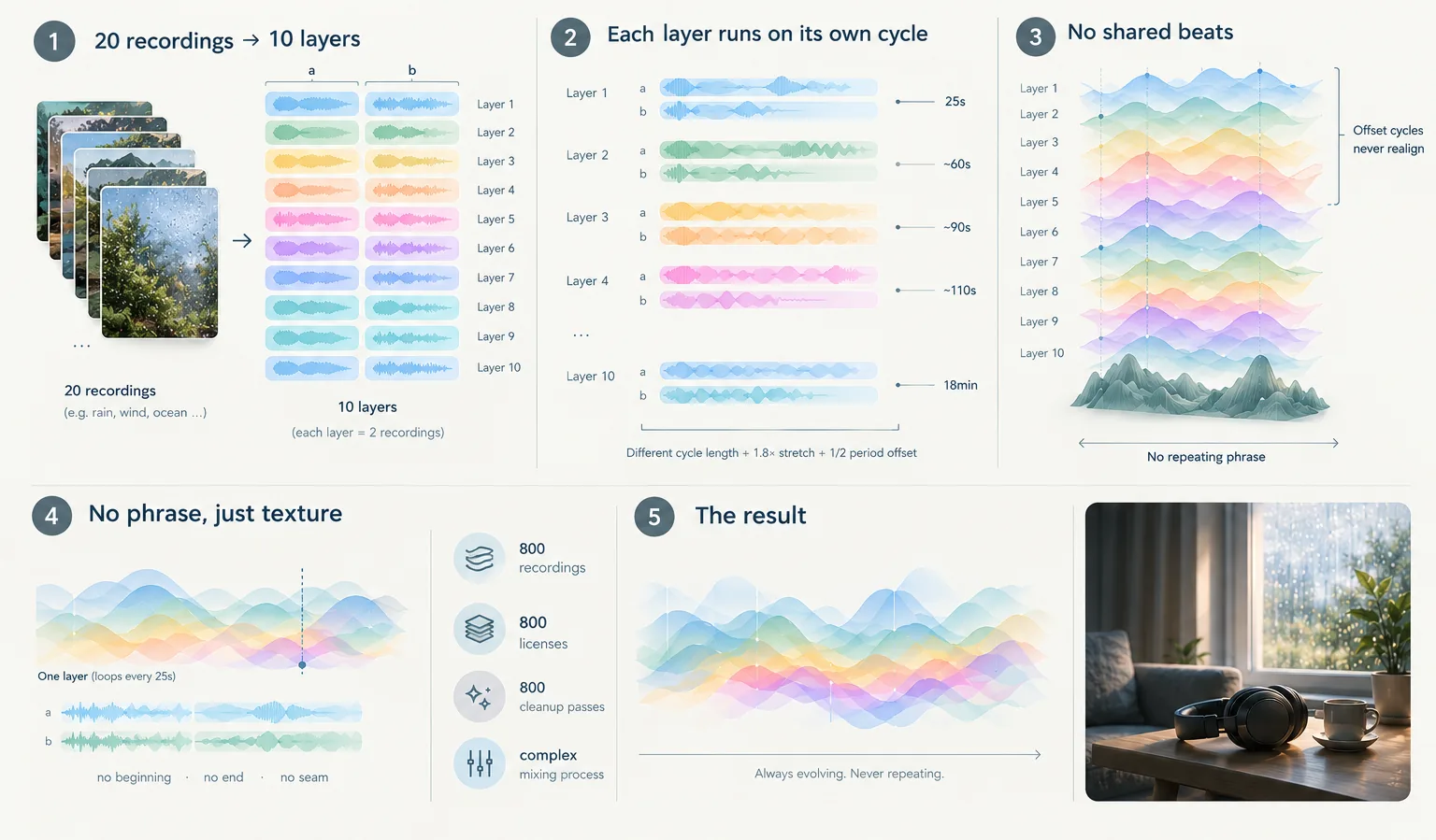
The point of that last part is what it prevents. If two layers shared a cycle, they’d recombine identically every time they met, and you’d hear a phrase again, just a longer one. Offset cycles don’t recombine. The rain you’re in at minute forty has never happened before, even though every layer in it has been playing since minute one.
We’re not claiming there’s no repetition. Our shortest layer repeats every 25 seconds. What we claim is narrower and more useful: a layer isn’t a phrase. There’s no beginning in it, no ending, nothing to learn and nothing to catch. You can hear one layer loop for an hour and never locate a seam, because a seam requires an edge, and we cut for texture instead of for edges.
The cost is real. Eight hundred recordings across forty soundscapes means eight hundred licenses, eight hundred passes of cleanup, and a mix that has to hold together in more combinations than anyone can audition by hand. One three-minute clip would have been cheaper in every respect. It also would have had a phrase in it.
06What this doesn’t fix
It doesn’t fix silence. If your nervous system wants nothing at all, a better soundscape is still a soundscape, and the honest advice is to turn it off.
It doesn’t fix a bad voice on top. A soundscape holds the room; the person talking is a separate problem, and a seam-free bed under a narrator who reads instead of speaks is still a session you’ll leave. That’s worth its own piece.
And it doesn’t fix the fact that disappearing isn’t what everyone wants. Adaptation means the sound goes away, and for some people that’s the opposite of comfort — they want evidence that something is still there. If you’re one of them, a texture you can’t hear was never going to help, and no amount of layering will change that.
Find a seam in ten minutes.
Forty soundscapes, built this way. Pick one and listen for the seam. If you find one, tell me where — support@getrestateapp.com. I’d rather know.
Open Restate ›07Questions, answered
Do your soundscapes loop?
Every layer does. The combination doesn’t. The shortest layer cycles every 25 seconds and the longest every 18 minutes, offset so they never realign. There’s no single moment where the whole thing starts again.
I stop hearing it after five minutes. Is that bad?
That’s the intended result. It’s adaptation, and it means the sound has stopped competing for attention. A loop breaks it by re-announcing itself every cycle, which is why some people can’t settle on one for an hour.
What exactly is a seam?
The join where a clip’s end meets its beginning. Usually under half a second, often a small dip or click, always in the same place. You can find yours by playing any ambient track three times and turning the volume down on the third pass.
How long before I decide a soundscape isn’t for me?
Longer than one pass. The first pass tells you almost nothing, because you haven’t learned the schedule yet. Give it three, and notice whether you’re still in the room or already listening to the file.